
You’re staring at a property portal that used to work and now doesn’t. Maybe Zillow started returning blocked pages, maybe Rightmove loads blank HTML, or maybe your old scraper still runs but the output no longer matches the site.
That’s usually the moment people realize real estate website scraping isn’t just about pulling today’s listings. It’s about building a pipeline that can survive layout changes, capture status and price changes, and keep a clean history of the same property as it moves across portals.
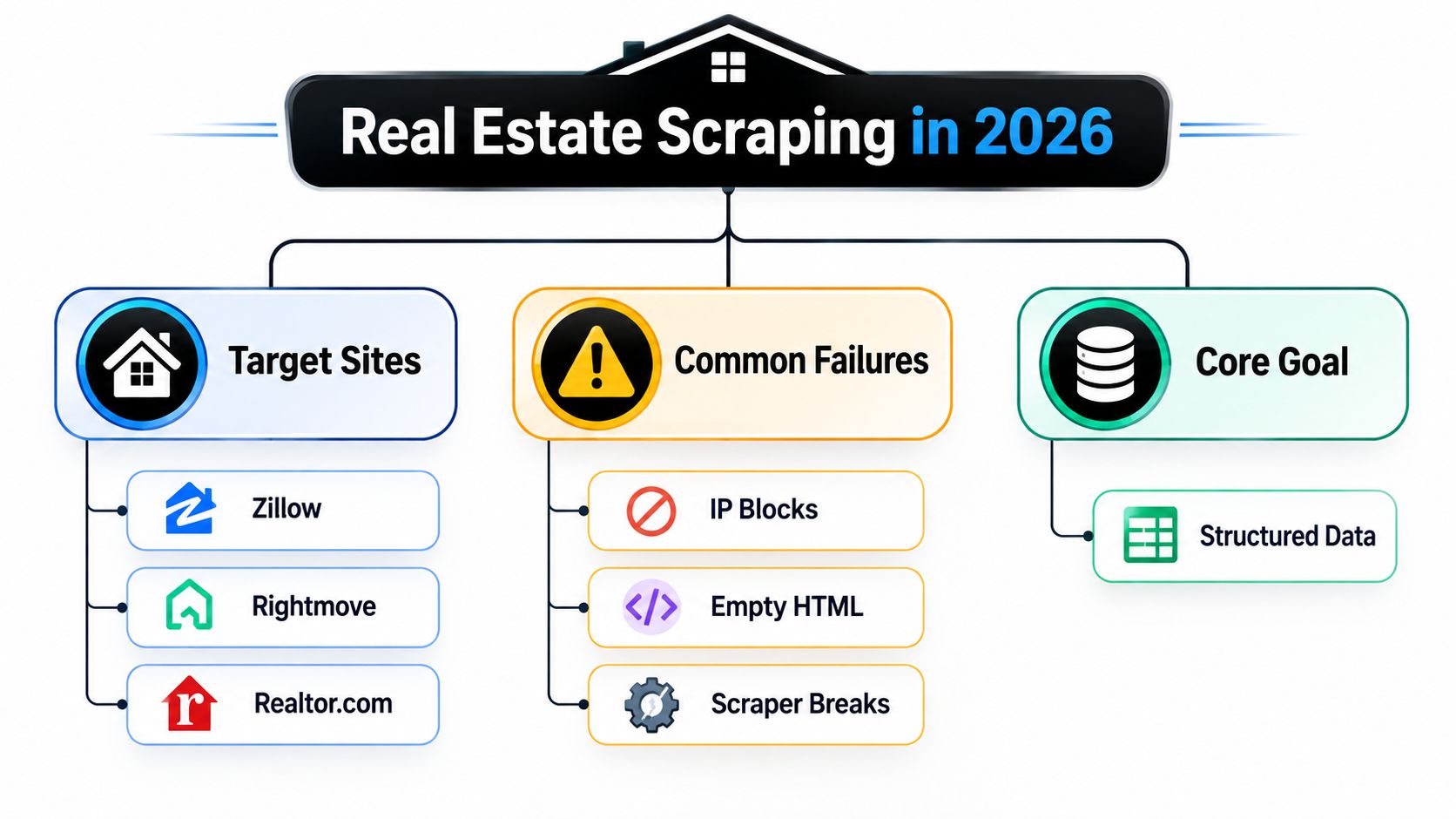
The useful output is rarely a single snapshot. It’s the combination of listing status, price-cut history, DOM resets, agent metadata, geocodes, and the raw DOM shape that tells you when a page changed and when the market changed.
For ML-oriented teams, the same mindset shows up in AI workflows for real estate analysis, because the extraction layer only matters if the dataset stays usable over time.
What Real Estate Scraping Actually Involves in 2026
A lot of developers start with the wrong question. They ask how to get the price and address off a listing page, then wonder why the system breaks the first time a card layout changes or a property gets relisted under a new record. The better question is how to build a dataset that can answer market questions later, not just scrape a page once.
A historical turning point came during the COVID shock, when the Banque de France documented an at least 80% decline in new property listings during the first UK lockdown, plus 90% of listings still available after one month at the height of the lockdown versus about two-thirds outside it, while real-estate websites were already producing more than 1.5 million listings downloaded on average every day (Banque de France study). That matters because it shows why scraped listings became a practical way to observe conditions in near real time when official reporting lagged.
The data you want goes beyond the obvious fields. You need the page shape, the listing lifecycle, the source URL, and often signals like neighborhood scores or coordinates. Some platforms expose more in detail pages, some hide useful data behind interaction, and some only become valuable when you can connect one portal’s record to another portal’s duplicate.
Practical rule: if the output can’t tell you whether a listing is new, relisted, updated, or stale, it isn’t production-ready.
Real estate scraping in 2026 is better thought of as a two-phase system. First you discover URLs from search or map results. Then you visit each detail page, extract a typed record, and store enough history to reconstruct change later. That’s the difference between a disposable scraper and a market-intelligence pipeline.
Setting Up the Crawl with Playwright and Puppeteer
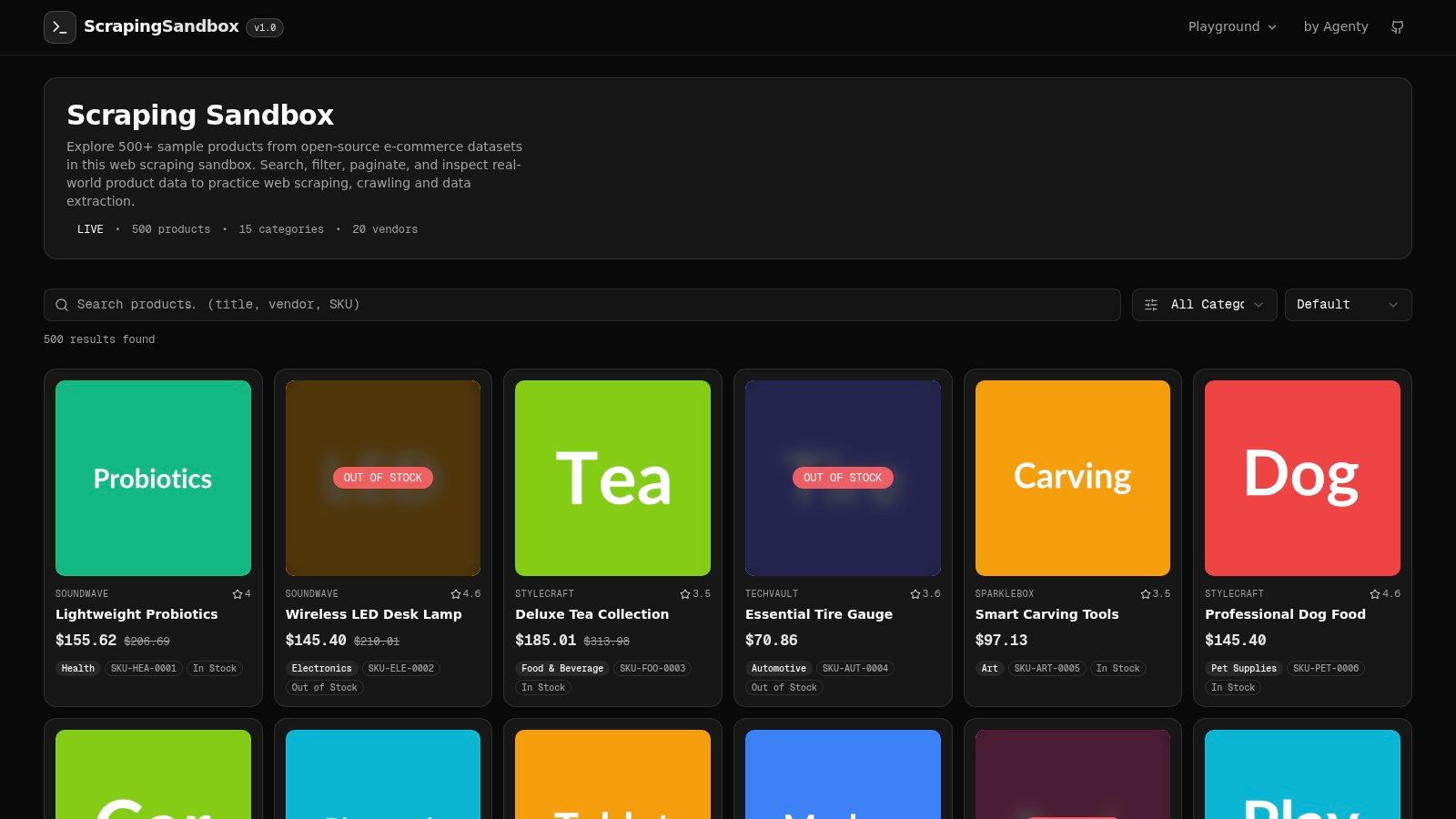
The cleanest place to start is a demo target that won’t punish you for learning. For that, use the Scraping Sandbox site at scrapingsandbox.com, because the same two-phase crawl pattern you practice there is what you’ll use on real portals.
The first phase collects listing URLs. The second phase visits each listing page and extracts the fields you care about. That split matters because search pages and detail pages almost never share the same structure, and trying to do everything in one pass usually produces brittle code.
Playwright in Python
import asyncio
from pathlib import Path
from playwright.async_api import async_playwright

QUEUE_FILE = Path("listing_urls.txt")

async def main():
    async with async_playwright() as p:
        browser = await p.chromium.launch(headless=True)
        context = await browser.new_context(
            viewport={"width": 1440, "height": 1200},
            storage_state="state.json"
        )
        page = await context.new_page()

        await page.goto("https://scrapingsandbox.com/", wait_until="networkidle")
        await page.wait_for_selector("a")

        urls = set()
        for _ in range(3):
            links = await page.locator("a[href]").evaluate_all(
                "(els) => els.map(e => e.href).filter(h => h.includes('/product/'))"
            )
            urls.update(links)

            next_btn = page.locator("a:has-text('Next'), button:has-text('Next')")
            if await next_btn.count() == 0:
                break
            await next_btn.first.click()
            await page.wait_for_load_state("networkidle")

        QUEUE_FILE.write_text("\n".join(sorted(urls)))

        detail_page = await context.new_page()
        for url in sorted(urls):
            await detail_page.goto(url, wait_until="networkidle")
            title = await detail_page.locator("h1").inner_text()
            print(url, title)

        await context.storage_state(path="state.json")
        await browser.close()

asyncio.run(main())
Puppeteer in Node.js
const fs = require("fs");
const puppeteer = require("puppeteer");

(async () => {
  const browser = await puppeteer.launch({ headless: true });
  const context = await browser.createBrowserContext();
  const page = await context.newPage();

  await page.setViewport({ width: 1440, height: 1200 });
  await page.goto("https://scrapingsandbox.com/", { waitUntil: "networkidle2" });
  await page.waitForSelector("a");

  const urls = new Set();

  for (let i = 0; i < 3; i++) {
    const links = await page.$$eval("a[href]", els =>
      els.map(e => e.href).filter(h => h.includes("/product/"))
    );
    links.forEach(url => urls.add(url));

    const nextBtn = await page.$("a:has-text('Next'), button:has-text('Next')");
    if (!nextBtn) break;
    await nextBtn.click();
    await page.waitForNetworkIdle();
  }

  fs.writeFileSync("listing_urls.txt", [...urls].sort().join("\n"));

  const detail = await context.newPage();
  for (const url of urls) {
    await detail.goto(url, { waitUntil: "networkidle2" });
    const title = await detail.$eval("h1", el => el.textContent.trim());
    console.log(url, title);
  }

  await browser.close();
})();
The important detail isn’t the library choice. It’s the discipline around cookie persistence, viewport stability, and waiting on the right page signal. If you need a broader implementation reference, Agenty’s playwright scraping guide is useful for the browser lifecycle details.
Keep the search crawl and detail crawl separate. Mixing them is how teams accidentally turn a maintainable scraper into a debugging project.
Designing a Resilient Extraction Schema
Once the crawler can reach pages, extraction becomes the next failure point. Selector chains that look fine on a single page often collapse when a portal changes a class name, moves a price block, or lazy-loads key content after scroll.
The fix is to define the schema first, then extract into it. A typed record gives you a contract for what matters, and it forces you to think about lifecycle fields instead of only page fields.
Start With the record shape
A practical listing schema usually includes id, address, price, beds, baths, area_sqft, lat, lng, status, first_seen_at, last_seen_at, and source_url. That structure is aligned with production advice to normalize, validate, batch, and diff records rather than trust raw page output (reliable path for real-estate data scraping).
from dataclasses import dataclass
from typing import Optional

@dataclass
class Listing:
    id: str
    address: str
    price: Optional[str]
    beds: Optional[float]
    baths: Optional[float]
    area_sqft: Optional[int]
    lat: Optional[float]
    lng: Optional[float]
    status: Optional[str]
    first_seen_at: Optional[str]
    last_seen_at: Optional[str]
    source_url: str
Selectors should be layered. Use CSS for stable visual hooks, XPath for fallback traversal, and JSON-LD when the page exposes structured data. That last option is often the most resilient when the rendered UI gets rewritten.
import json
from bs4 import BeautifulSoup

def extract_json_ld(html):
    soup = BeautifulSoup(html, "html.parser")
    for tag in soup.select('script[type="application/ld+json"]'):
        try:
            data = json.loads(tag.get_text(strip=True))
            if isinstance(data, dict) and data.get("@type") in {"Product", "Residence", "House"}:
                return data
        except Exception:
            continue
    return None
Handle dynamic content like a collector not a guesser
Lazy-loaded images, infinite scroll and hidden panels need explicit waits. Don’t assume the first DOM snapshot is complete. If a portal uses interaction to reveal property history or extra specs, your scraper should either click through that state or fall back to embedded data.
Scraping detail pages from listings is worth skimming if you want to see the extraction problem from the detail-page side instead of the search-page side.
The main habit to build is this, extract against the schema, then validate the values. If the page changes, your pipeline should fail loudly instead of writing partial garbage.

Anti-Detection, Proxies and Rate Limits That Actually Work
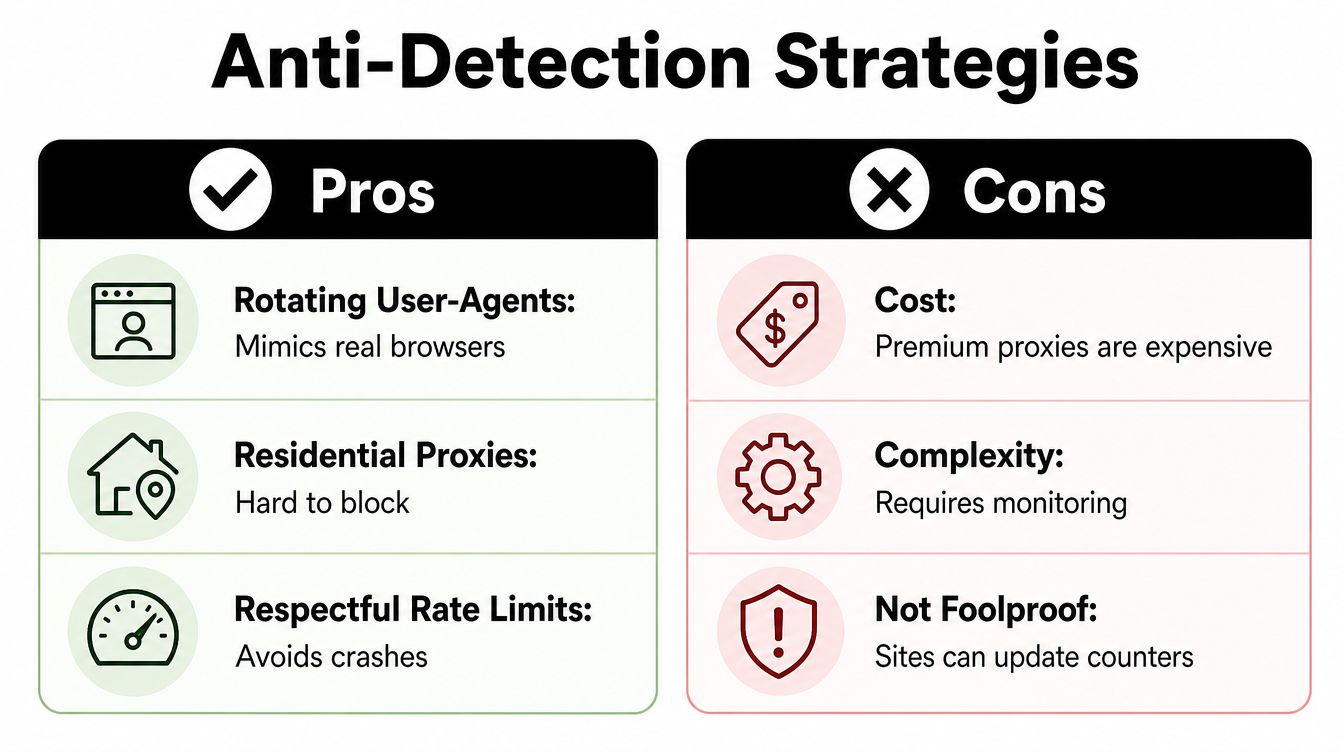
Most real estate scraping projects don’t die because the parser is weak. They die because the crawler starts behaving like an obvious bot, then the target site tightens its checks and the pipeline falls apart.
The practical approach is boring and that’s a good thing. Use honest user-agent strings, keep request frequency low, and respect robots.txt as the default posture.
What actually survives contact with real portals
For portals with strict anti-bot controls, sticky sessions matter because the crawl is usually two-phased. You want continuity while collecting listing URLs, then the same continuity while visiting detail pages. That reduces suspicious churn and makes debug traces easier to interpret.
- Residential proxies: Use them for geo-sensitive inventory and local portal access, especially when the target market expects regional traffic.
- Sticky sessions: Keep the same session alive through a search crawl and its detail-page visits.
- Low concurrency: Limit parallel requests per domain so you don’t create avoidable blocks.
- Honest headers: Send a normal user agent and don’t pretend to be a different browser family every few requests.
- Managed scraping APIs: Use them when fingerprinting, retries, and session rotation are consuming engineering time better spent on data quality.
Practical rule: if your crawl only works at tiny volume, the problem isn’t scale yet. The problem is access control.
For high-volume production jobs, managed services help because they absorb browser fingerprinting, retries, and session rotation. Agenty is one option in that category, especially when the team wants scheduling, proxies and change detection behind a hosted service rather than stitched together locally.
Scheduling, Monitoring, and Change Detection Over Time
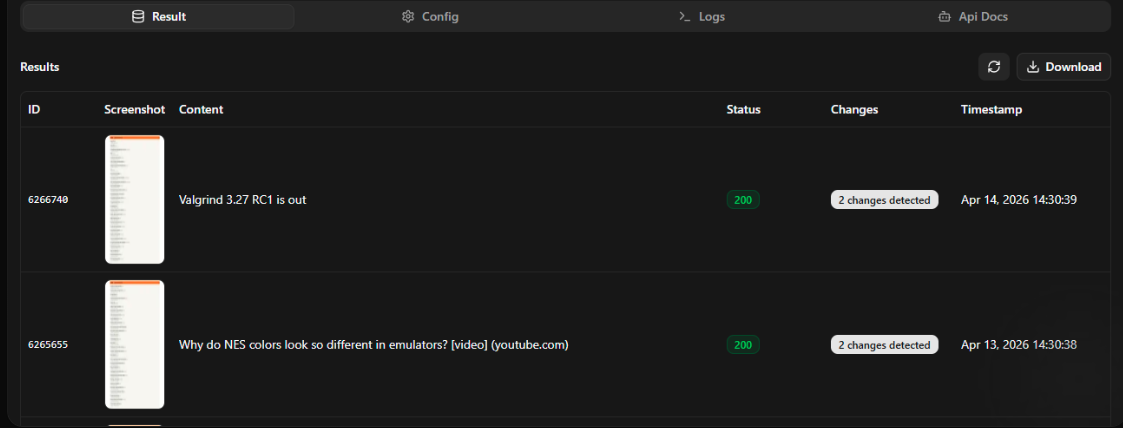
A scraper that ran once is not a pipeline. If you want actual market intelligence, the job has to come back on a schedule, compare new runs against old runs, and tell you when the page or the listing itself changed.
The core pattern is simple. Store each run, record the response status, keep parse counts, and persist change events separately from raw extractions. That way, a page redesign doesn’t get confused with a price cut, and a delisting doesn’t get mistaken for a missing parser field.
Track inventory as events, not just records
The most useful timestamps are first_seen_at and last_seen_at. They let you tell new inventory from relisted properties, which is exactly where naive snapshot systems go wrong. You also want the page hash or a DOM fingerprint so a layout change shows up as a parsing problem instead of a market signal.
A practical schedule can be frequent for active markets and slower for lower-value segments. The right interval depends on the market question, not on what the crawler can technically tolerate.
When the same home appears on multiple runs, the question isn’t “is it new.” The question is whether the entity changed, or only the portal record changed.
Monitor for failure modes separately
You need two alert streams. One for scraper health, one for market changes. If the parser starts missing a price field across many pages, that’s a scraper problem. If the price field changes on one page while the DOM remains stable, that’s a market event.
A durable system stores run history, error diagnostics, and the previous version of each listing page. That makes it possible to inspect how the portal moved instead of guessing after the fact.
The underused move here is change detection on the listing page itself, not just the detail page. A simple watcher can tell you when the portal changed a price badge, status label, or hidden field, and that gives you a cleaner historical dataset than one-off crawls ever can.
Cleaning, Normalizing and Deduplicating Across Portals
Raw real estate data is messy in ways that aren’t obvious until you try to join it. One portal uses miles, another uses square meters. One includes neighborhood text in the address line, another separates it. One listing appears on two sites with different titles and slightly different photos.
That’s why the highest-value work happens after extraction. The core job is entity resolution, not web page scraping. A broad overview of real estate data sources shows why, since serious coverage pulls from MLS-style portals, brokerages, government property-tax and zoning pages, property-management sites, news and blogs, REIT sites, classifieds, and social platforms (real estate data sources overview).
Separate scraper failures from market-data changes
| Signal | Scraper Failure | Market Change |
|---|---|---|
| Missing price on many pages | Selector broke or the page structure changed | Unlikely if only one source changed |
| New status label on one listing | Likely valid extraction if other fields still parse | Listing may have sold, been withdrawn, or relisted |
| Address formatting shifts across portals | Normalization issue | Same property may still be the same entity |
| Duplicate record appears from another portal | Dedup logic may be weak | Same home can legitimately appear multiple times |
The key cleanup steps are straightforward. Standardize addresses, geocode where possible, and compare records across platforms before you treat them as unique properties. That work matters because a dashboard built on naive snapshots can make a relisted home look like fresh supply when it’s really the same entity under a new wrapper.
The contrarian point is that volume isn’t the win. Freshness, entity resolution, and event history are the win. A smaller dataset with clean time-series behavior beats a larger dataset that can’t tell a relist from a new listing.
If you’re operating globally, normalization gets harder because address formats, currencies, and language vary by market. The pipeline needs to be location-aware, not just site-aware, or you’ll end up with records that look structured but don’t compare cleanly.
Export, Integration and Staying on the Right Side of the Law
Once the data is clean, export it in the shape your downstream system wants. JSON works for APIs and services, CSV still works for analysts, and Markdown can be useful when the next step is LLM training or content review. If you’re wiring it into operations, webhooks, S3, and database sinks are the usual handoff points.
A service-style scraper should expose a REST API so engineering teams can trigger jobs without opening the browser. cURL, Python, and JavaScript clients are the normal way to do that, and they make the scraper behave like infrastructure instead of a one-off script.
The legal and ethical side is not optional. Respect robots.txt, honor terms of service, throttle requests, and avoid scraping personal data beyond public listings. Treat PII carefully, especially when the page mixes listing content with agent or owner details.
Before you scale from pilot to production, verify five things, access stability, schema validation, dedup logic, run monitoring, and export reliability. If all five hold up in a small market slice, you’re in a much better place to expand.