
Your scraper usually doesn’t fail during a calm week. It fails when the dashboard refresh is due, the pricing file has to land before a meeting, or a downstream model suddenly starts reading nulls because one product card class changed overnight.
That’s the reason teams move to web scraping as a service. The value isn’t just “we can get data from websites.” Most engineering teams can already do that. The value is getting structured, trustworthy data on schedule, with fewer silent failures, fewer brittle selectors, and less engineering time burned on anti-bot work that adds no product differentiation.
A lot of in-house scraping efforts start the same way. One script becomes three. Then you add Playwright for JavaScript rendering, a proxy provider for block avoidance, a cron job, a retry loop, and a cleanup script for malformed output. After a few months, you haven’t built a data product. You’ve built an operations problem.

The End of Brittle Manual Scraping
Monday at 8:55 a.m., the dashboard refresh finishes on time and nobody gets alerted. By 9:10, a pricing analyst notices half the SKUs have blank prices and duplicated variants. The scraper did not crash. It delivered a file that looked valid enough to pass through the pipeline.
That is how manual scraping usually fails in production. The job completes, the JSON parses, and the bad data keeps moving.
Brittle scraping erodes trust before it triggers an incident.
A selector misses one nested span. A site swaps server-rendered HTML for lazy-loaded components. Pagination changes from page numbers to cursor-based requests. The extraction code still returns output, but field coverage drops, records drift out of schema, and downstream logic starts making decisions on incomplete data. In practice, silent degradation costs more than a hard stop because teams keep acting on the result.
The core problem is not just collection. It is operational reliability across the full path from page render to validated dataset. Once a scraper is part of a reporting workflow, pricing monitor, lead feed, or model input, the standard changes. The job is no longer “get the page.” The job is “deliver correct, structured data on schedule, with enough validation to catch breakage before a user does.”
That requirement changes what teams need to own.
Running scraping in-house means maintaining browser automation, proxy pools, request pacing, session handling, retry policies, parsers, schema mappings, and monitors for data freshness and field-level accuracy. None of that is impossible. I have built these systems. The trade-off is that every hour spent fixing bot defenses or repairing selectors is an hour not spent improving the product that depends on the data.
A managed scraping service shifts the work to a more useful boundary. The team defines the target sites, the fields, the refresh cadence, the output schema, and the acceptance rules. The service handles the unstable layers, especially the parts that break often: browser execution, proxy routing, extraction maintenance, and delivery retries.
That matters because reliable scraping is really a data quality problem disguised as an access problem.
The teams that get the most value from scraping as a service are usually not looking for a shortcut. They are choosing a better operating model. They want parsers that adapt when markup changes, proxy infrastructure that keeps collection stable, and delivery pipelines that fail loudly when required fields go missing or record counts suddenly collapse.
A practical rule helps here. If engineers spend more time repairing extraction than checking whether the data is fit for use, the scraper has become infrastructure. At that point, reliability, validation, and SLA-backed delivery usually matter more than owning every selector.
What changes when scraping is treated like a production pipeline
Mature scraping systems are judged by data quality metrics, not by whether an HTTP request succeeded. Useful questions are more specific:
- Did required fields populate at expected rates?
- Did the record count move outside a normal range?
- Did the provider return normalized output that matches the agreed schema?
- Did the run finish within the delivery window?
- Did validation catch layout drift before bad data reached downstream systems?
That is the definitive break from brittle manual scraping. The goal is not raw extraction. The goal is a dependable pipeline that produces trustworthy data, even when the source site changes underneath it.
Teams that adopt web scraping as a service are usually making that decision on purpose. They want current data, structured output, and fewer hidden failures. Owning less scraping infrastructure is often the byproduct, not the reason.
What Is Web Scraping as a Service and How Does It Work
Consider shipping logistics. You can buy vans, hire drivers, manage routes, fuel, maintenance, and delivery exceptions yourself. Or you can hand the package to a carrier that already runs the fleet, tracking, routing, and last-mile delivery.
Web scraping as a service works the same way. You specify the data and the service operates the collection system.
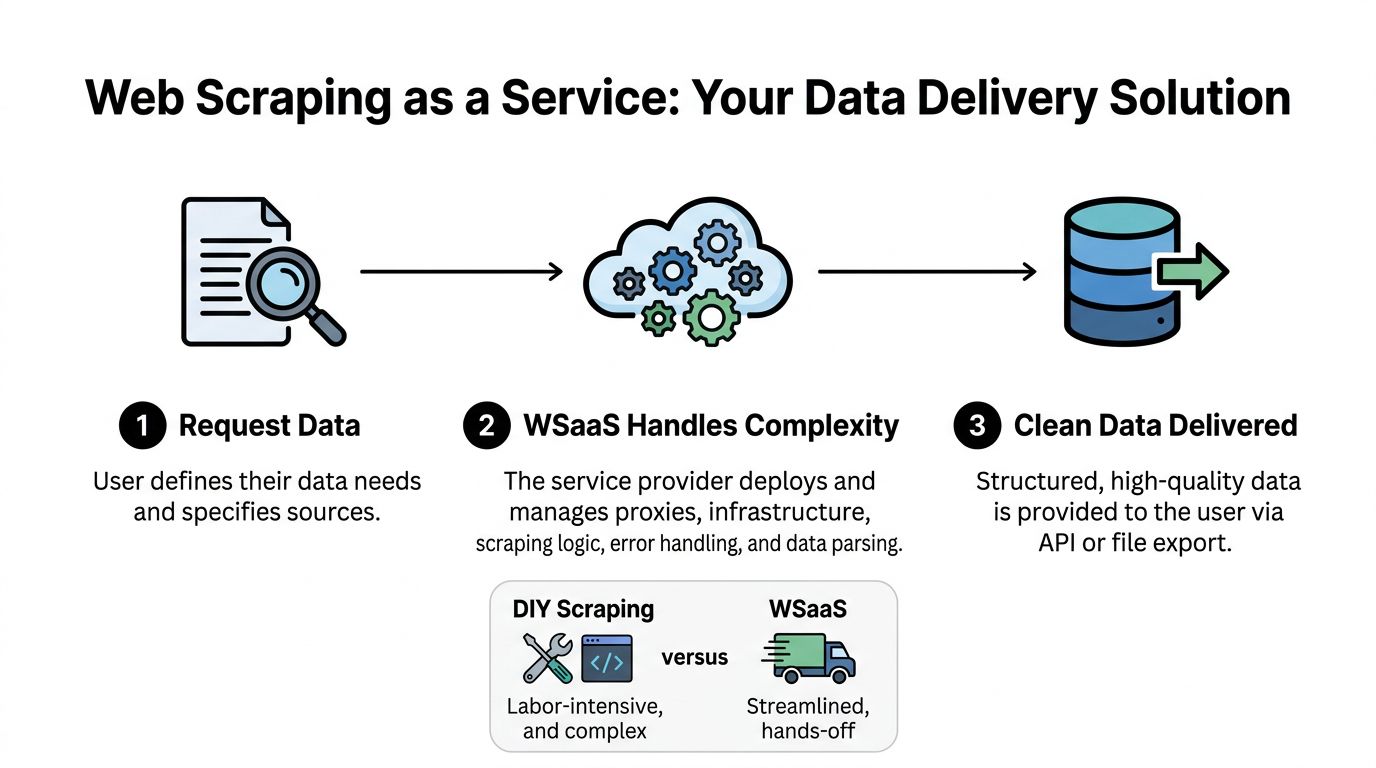
In the do-it-yourself model, you assemble libraries, browsers, proxies, parsers, storage, and monitoring. In the service model, those parts are already integrated into one operating system for data extraction.
The service stack behind the API
A proper scraping service is more than a scraping library wrapped in HTTP. It usually combines several layers:
- Crawlers for navigation. These discover category pages, follow pagination, traverse detail pages, and maintain URL queues.
- Browser automation for rendering. This handles JavaScript-heavy sites, interactions, waits, clicks, and authenticated sessions when needed.
- Proxy infrastructure for access. Residential and static IP pools help with geo-sensitive targets, request distribution, and block avoidance.
- Parsers and transformers for structure. Raw HTML isn’t usually the deliverable. Teams need normalized JSON, CSV, or database-ready records.
- Delivery APIs and exports. Data lands through REST APIs, webhooks, cloud storage, or scheduled exports.
The newer layer is adaptive extraction. The global AI-driven web scraping market was valued at $886.0 million in 2025 and is set to reach $1,039.3 million by the end of 2026, with Paid Services holding 68.3% market share, according to Future Market Insights on AI-driven web scraping. That matters because it reflects a practical preference. Businesses usually don’t want to maintain the infrastructure themselves.
How the workflow usually looks in practice
From an engineering perspective, the flow is straightforward:
-
Define the job
Specify target URLs or site patterns, desired fields, refresh frequency, and output format. -
Let the service handle collection
The provider runs the crawler, browser sessions, request scheduling, retries, and parsing logic. -
Consume the output
Your application, warehouse, or pipeline receives structured data through an API or export.
The difference between a service and a raw library shows up in edge cases. If a page rate-limits requests, changes layout, or renders content late, a managed platform can absorb that operational complexity centrally.
The product isn’t the scraper. The product is dependable delivery of usable data.
Why this beats a pile of utilities
A library like Playwright or Puppeteer is excellent for browser control. It is not, by itself, a managed data pipeline. Teams still need monitoring, schema checks, proxy strategy, job orchestration, and failure handling.
That’s why a service feels less like a developer tool and more like outsourced data operations. You ask for a clean dataset. The platform deals with the web’s messiness.
Managed Service vs In-House Scraping A Strategic Comparison
The build-versus-buy decision usually gets framed as cost. That’s incomplete. The bigger issue is operational ownership.
An in-house scraper can look cheap at first because the first version is often a single script and a scheduler. But a production-ready web scraping service requires a distributed microservices model with separate components for scheduling, scraping, parsing, and storage, coordinated through message queues for independent scaling and fault tolerance. That architecture is where many internal projects start to stall.
In-House Scraping vs Web Scraping as a Service
| Factor | In-House Scraping | Web Scraping as a Service |
|---|---|---|
| Initial setup | Fast for a small proof of concept, slower as targets and edge cases expand | Faster path to a usable pipeline when requirements are clear |
| Architecture burden | Team owns scheduling, workers, parsing, storage, queues, monitoring | Provider owns the distributed collection stack |
| Maintenance load | Internal engineers fix breakage, parser drift, proxy issues, and browser updates | Maintenance is externalized as part of the service |
| Scalability | Requires careful redesign once concurrency and target volume increase | Scaling is usually built into the platform model |
| Data quality controls | Must be designed, enforced, and monitored internally | Often part of the managed workflow and delivery contract |
| Specialized expertise | Needs browser automation, networking, anti-bot, parsing, and operations skills | Lets teams focus on consuming data instead of operating extraction |
| Time-to-value | Good for narrow targets, slower for multi-site, ongoing programs | Better when continuity matters more than code ownership |
| Control | Maximum implementation control | Less low-level control, but less operational drag |
What in-house still does well
There are cases where building internally makes sense:
- Narrow scope where one or two targets matter
- Short-lived projects that don’t justify vendor onboarding
- Highly custom interaction flows tied closely to proprietary internal logic
- Strong platform teams that already run browser infrastructure
If your scraping needs are limited and stable, a small internal stack can be efficient.
Where managed services win
Managed services become more attractive when the work stops being “fetch this page” and starts being “maintain this dataset without interruption.”
That usually means:
- many domains
- ongoing refresh schedules
- anti-bot pressure
- schema consistency requirements
- auditability for security and legal review
- downstream consumers who need reliable contracts
The strategic comparison is simple. If scraping is core intellectual property, build more of it yourself. If it’s a supporting capability, buying reliability is often the better engineering decision.
Core Features and Benefits of a Modern Scraping Service
The features that matter most aren’t flashy. They’re the ones that stop bad data from leaking into production.
Adaptive extraction matters more than one-time success
A scraper that works today isn’t necessarily useful next month. One of the sharpest realities in this space is that 70% of static scrapers fail within 3 weeks of target site updates, and modern systems respond with dynamic DOM adaptation and entity detection to preserve schema stability, according to GroupBWT’s write-up on web scraping as a service.
That number matches what many teams experience. Static selectors are fine for prototypes. Production pipelines need resilience.
A modern service should support:
- Layout-aware extraction that can survive markup shifts
- Entity-level parsing so fields map to meaning, not just position
- Schema stability checks that flag drift before data consumers notice it
- Run histories and diagnostics so operators can trace why a job changed
The business benefits behind the feature list
These platform features matter because each one removes a common failure path.
- Scheduled runs keep collections aligned with business cadence, whether you need frequent refreshes or a daily handoff.
- Automated cleaning and transformation turns raw page output into records that analysts and applications can use without another custom script.
- No-code or low-code configuration lets analysts or operations teams handle simpler targets without waiting for engineering capacity.
- Proxy and anti-detection controls reduce the chance that data freshness is held hostage by access issues.
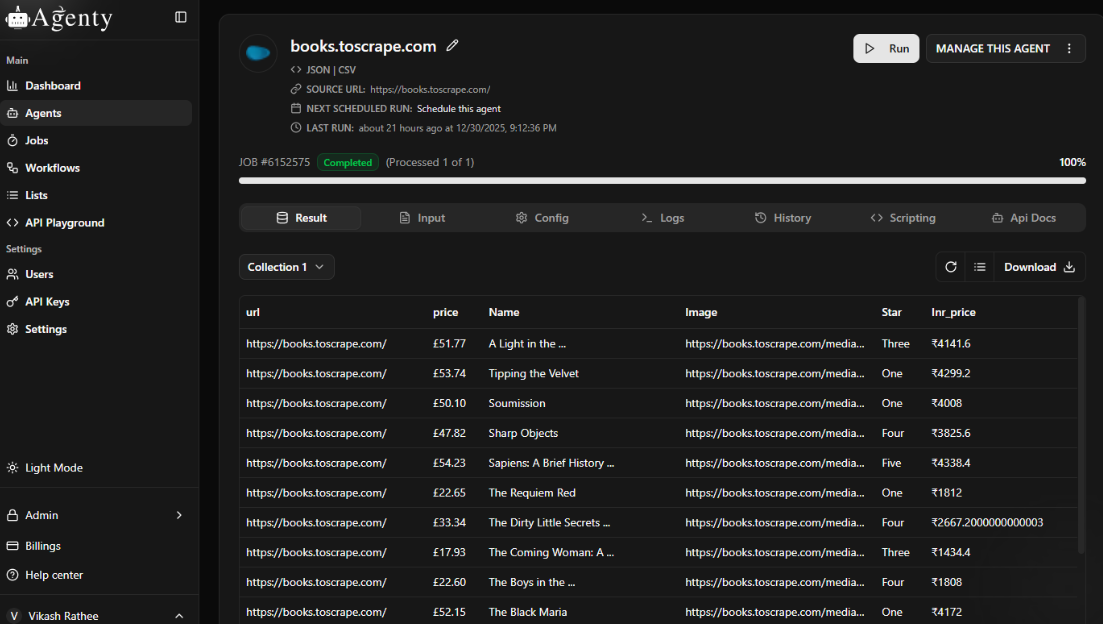
One practical example is Agenty’s Scraping Agent, which exposes AI-assisted extraction, crawling, scheduling, and structured delivery in a hosted workflow. That model is useful when the goal is less about browser scripting itself and more about maintaining a repeatable data feed.
Reliable scraping isn’t measured by whether the run completed. It’s measured by whether the output stayed consistent enough for someone else to trust it.
What to look for in feature claims
When vendors talk about AI, the useful question isn’t whether AI is present. It’s whether the system handles common break points:
- delayed JavaScript rendering
- nested cards and variant extraction
- changing labels and field positions
- paginated navigation
- duplicate records
- partial-page failures
If a service can’t show how it keeps data structure stable, it’s solving collection, not delivery.
Practical Integration with Headless Browser APIs
Even when you use web scraping as a service, browser automation still matters. Teams often mix both approaches. They use a managed platform for recurring production pipelines and keep Playwright or Puppeteer for prototyping, validation, or handling custom flows that need direct control.
The practical skill isn’t choosing one forever. It’s knowing where each fits.
Playwright example on Scraping Sandbox
The example below extracts product names and prices from the e-commerce demo on Scraping Sandbox. It uses browser automation directly, which is often how engineers test selectors before moving the logic into a managed job.
// npm install playwright
const { chromium } = require('playwright');

(async () => {
  const browser = await chromium.launch({ headless: true });
  const page = await browser.newPage();

  await page.goto('https://scrapingsandbox.com/', {
    waitUntil: 'networkidle'
  });

  await page.waitForSelector('.product-card');

  const products = await page.$$eval('.product-card', cards =>
    cards.map(card => {
      const nameEl = card.querySelector('.product-title');
      const priceEl = card.querySelector('.product-price');

      return {
        name: nameEl ? nameEl.textContent.trim() : null,
        price: priceEl ? priceEl.textContent.trim() : null
      };
    })
  );

  console.log(products);

  await browser.close();
})();
A few practical notes:
- Wait for stable rendering instead of scraping immediately after navigation.
- Guard selectors with null checks so one malformed card doesn’t crash the run.
- Validate output shape before sending records downstream.
Puppeteer example on Scraping Sandbox
Puppeteer gives a very similar pattern. If your team already uses Chrome DevTools heavily, this may feel more natural.
// npm install puppeteer
const puppeteer = require('puppeteer');

(async () => {
  const browser = await puppeteer.launch({
    headless: true
  });

  const page = await browser.newPage();

  await page.goto('https://scrapingsandbox.com/', {
    waitUntil: 'networkidle2'
  });

  await page.waitForSelector('.product-card');

  const products = await page.evaluate(() => {
    const cards = Array.from(document.querySelectorAll('.product-card'));

    return cards.map(card => {
      const name = card.querySelector('.product-title')?.textContent?.trim() || null;
      const price = card.querySelector('.product-price')?.textContent?.trim() || null;

      return { name, price };
    });
  });

  console.log(products);

  await browser.close();
})();
Where a service fits into this workflow
Once the selectors are verified, many teams move the recurring job into a managed platform so they don’t have to operate the browser fleet themselves. In practice, the handoff often looks like this:
- Prototype selectors in Playwright or Puppeteer.
- Confirm the rendered DOM and edge cases.
- Define the target schema.
- Schedule production extraction in a service.
- Consume the resulting dataset through API or export.
For implementation details around hosted extraction, crawl jobs, and delivery patterns, a provider’s developer documentation matters more than marketing pages. You want to see request models, auth flow, result retrieval, retries, and job lifecycle behavior.
Keep the browser code for discovery and debugging. Move the repetitive, failure-prone execution into a system built to run it every day.
Essential Best Practices for Reliable and Ethical Scraping
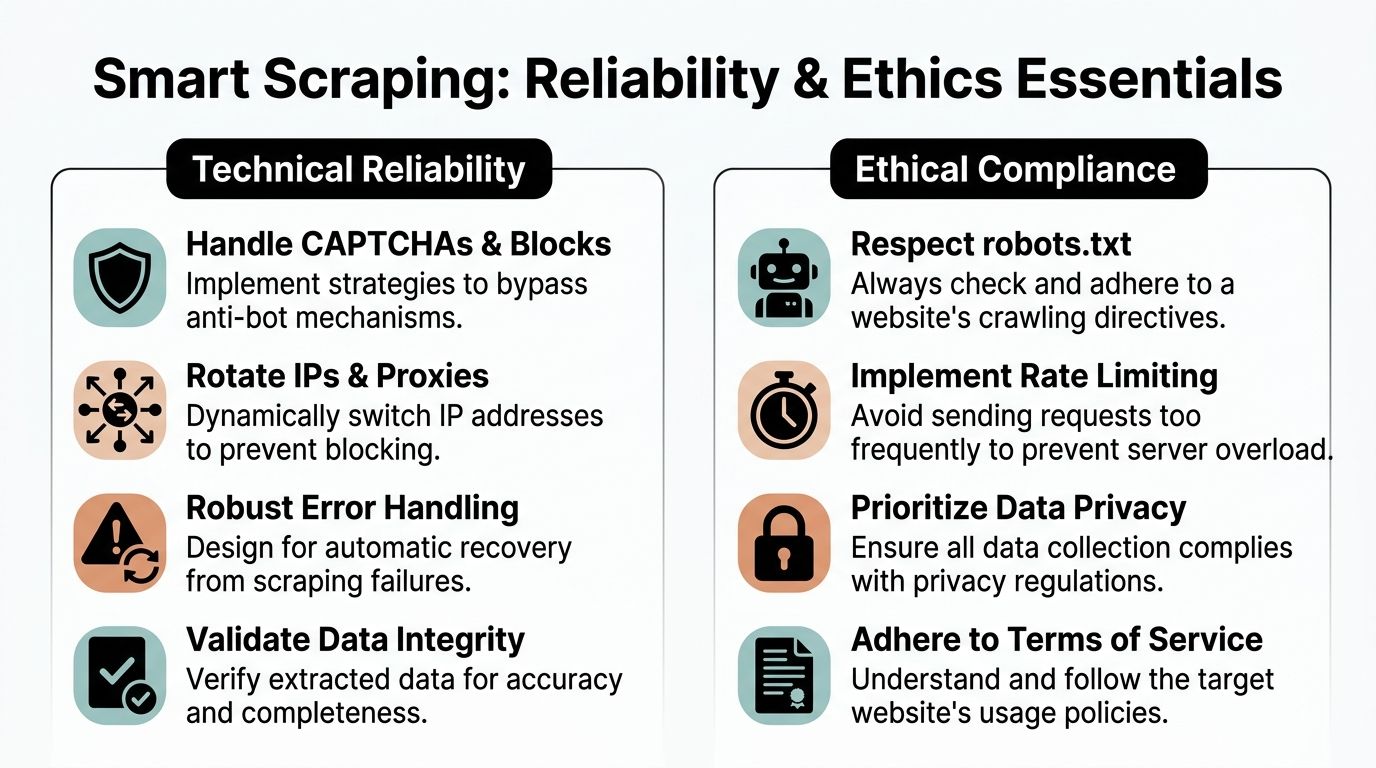
Reliable scraping has two halves. One is technical discipline. The other is compliance discipline. Teams often over-invest in the first and hand-wave the second until legal or security reviews get involved.
Technical reliability that actually holds up
High-throughput scraping works better when request behavior is controlled, not aggressive. A practical set of controls: exponential backoff, circuit breakers, fallback proxy strategies, intelligent caching, and quality degradation alerts. That’s the kind of thinking that keeps a pipeline running under pressure.
Use these patterns consistently:
- Rate limit intentionally so the collector behaves predictably instead of hammering endpoints.
- Apply exponential backoff when requests fail, rather than retrying instantly and escalating the block.
- Use circuit breakers to stop bad request loops when failure rates spike.
- Rotate proxy types carefully because residential and static IPs solve different access problems.
- Validate records at extraction time so empty fields, duplicates, and malformed values don’t slip through unnoticed.
A stable scraper is usually a polite scraper. A lot of block avoidance comes from sane request behavior, not just bigger proxy pools.
Ethical and legal controls can’t be an afterthought
The legal side is often underexplained, even though it’s central to production use. The angle of Ethical & Legal Compliance as a Service matters because 60% of web scraping projects in the US face legal risks, including issues around robots.txt, trespass to chattels, data access agreements, and CFAA concerns, according to the GSA discussion of web scraping risks.
That doesn’t mean scraping is off-limits. It means teams need rules.
- Respect robots.txt as part of your review process, not as a last-minute checkbox.
- Review terms of service before scaling collection against any domain.
- Filter sensitive data and keep privacy requirements in scope for storage and downstream sharing.
- Document purpose and access controls so legal, security, and engineering all understand what’s being collected and why.
Reliability and compliance reinforce each other
Engineering teams sometimes separate “uptime” from “governance.” In practice, they’re linked. The same maturity that gives you controlled retries, logging, and data validation also makes audits and legal review easier.
Good scraping operations aren’t just hard to block. They’re easy to explain.
Choosing a Provider and Measuring ROI
A scraper that returns data today but breaks next Tuesday is not a service. It is outsourced maintenance. The key buying decision is whether the vendor can keep a structured feed reliable as target sites change, anti-bot rules tighten, and downstream teams depend on the output.
Spending in this category is rising, and pricing already reflects a clear split between basic extraction plans and managed pipelines with support, browser automation, proxy orchestration, and data QA. Small plans often cover simple scheduled jobs. Higher-tier engagements usually include custom parsers, monitoring, retries, and service support because that is what keeps business-critical feeds usable over time.
Provider checklist
Start with failure handling, not feature lists. Any vendor can demo a successful scrape on a clean page. The harder question is what happens after a login flow changes, a product grid starts lazy-loading, or a target begins rate-limiting by ASN and geography.
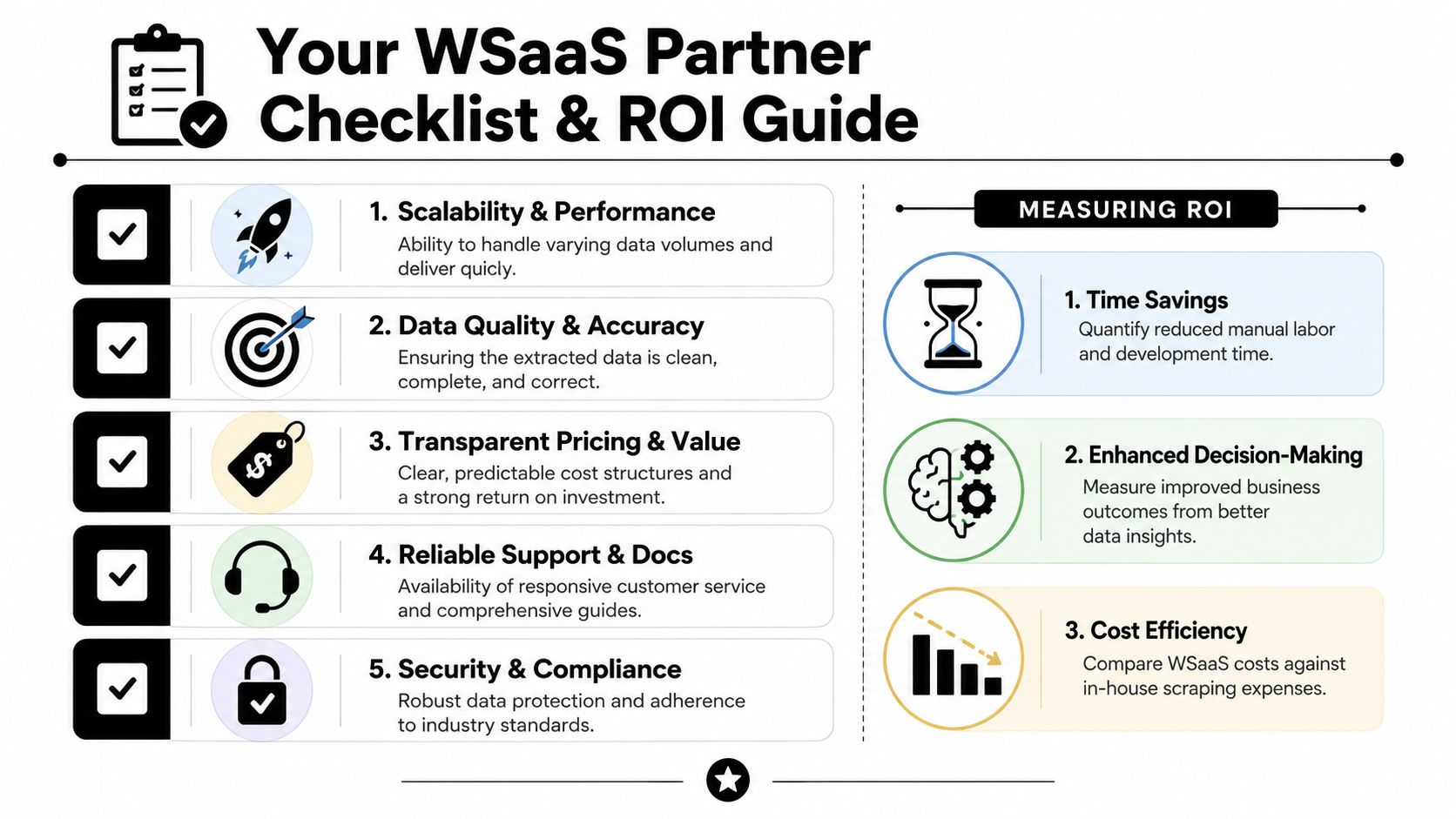
Use this checklist:
- API quality. Look for clear job creation, status polling, webhooks, retry behavior, and export formats that fit your pipeline.
- Data quality controls. Ask how the provider detects schema drift, duplicate records, null-heavy fields, and malformed output before it reaches your warehouse.
- Browser and proxy stack. The service should support headless browsers, session handling, residential or datacenter proxies where appropriate, and geo-targeting for region-specific pages.
- Observability. You need run logs, screenshots, error diagnostics, and enough traceability to explain why a job failed or why record counts dropped.
- Support model. Response time matters when the feed drives pricing, inventory, lead enrichment, or compliance monitoring.
- Compliance posture. The provider should be able to explain retention rules, access controls, and how they review collection boundaries.
Pricing pages can help translate those differences into operating cost. A live hosted scraping platform pricing page shows whether the vendor is charging for requests, browser time, records, support, or some combination of all four.
A practical ROI formula
A useful ROI model stays close to operating reality:
ROI = hours not spent maintaining scrapers + value of faster, usable data + cost avoided from bad or missing data - service cost
The first term is easy to underestimate. Internal teams rarely count the time spent repairing selectors, rotating proxies, re-running failed jobs, validating broken exports, and answering questions from analysts who noticed missing rows. That work is real cost, even if it never appears as a line item.
The second and third terms usually matter more. Reliable delivery means analysts get structured data on schedule. Forecasts stop swinging because one source changed markup unnoticed. Pricing and assortment teams stop making decisions on stale snapshots. If a managed service catches a schema change before it corrupts a dashboard or model input, that prevention has more value than the raw scrape itself.
The best ROI cases share one pattern. The data is recurring, operational, and sensitive to breakage. In those cases, the service is buying reliability, not just extraction.