
Modern e-commerce operates at a speed and scale that makes manual pricing updates obsolete. To maintain profit margins and stay competitive, online merchants rely heavily on dynamic pricing algorithms that adjust product prices in response to real-time market shifts. While traditional pricing was governed purely by baseline supply and demand models, artificial intelligence (AI) has shifted the equation by incorporating deep customer-level insights and granular market intelligence.
By analyzing vast streams of structured data like inventory levels, competitor movements, browsing history, and purchasing power. The AI models calculate the optimal price point a customer is willing to pay at any given moment. This transformation enables retailers to respond instantly to shifts in consumer demand while maintaining healthy profit margins.

Understanding Dynamic Pricing in Online Retail
Dynamic pricing is a flexible pricing strategy where product rates automatically adjust based on current market conditions. Unlike brick-and-mortar retail, where price changes require physical labor and are limited by geography, digital storefronts can update thousands of SKUs in seconds.
In traditional commerce, a seller might track a few local competitors across a limited catalog. In e-commerce, millions of products compete globally 24/7, with prices changing multiple times per hour. Major marketplaces like Amazon and Walmart constantly ingest external market data using automated competitor price monitoring tools to reprice items rapidly and capture consumer demand.
Retailers operating without automated pricing mechanisms risk two costly outcomes:
- Overpricing items, which leads to abandoned shopping carts, reduced search visibility, and lost market share.
- Underpricing items, which burns through inventory prematurely and leaves significant profit margins on the table.
How AI and Machine Learning Power Dynamic Pricing Engines
At the core of modern dynamic pricing is machine learning (ML). Traditional rules-based pricing tools rely on rigid “if-then” conditions (e.g., if Competitor A drops price by 5%, match lower price). While useful, rules-based logic quickly breaks down when managing complex catalog dependencies, aggressive price wars, or unpredictable demand spikes.
AI-driven pricing engines go beyond basic static rules. Machine learning models continuously analyze past sales data, recognize emerging trends, and predict how consumers will react to subtle price adjustments.
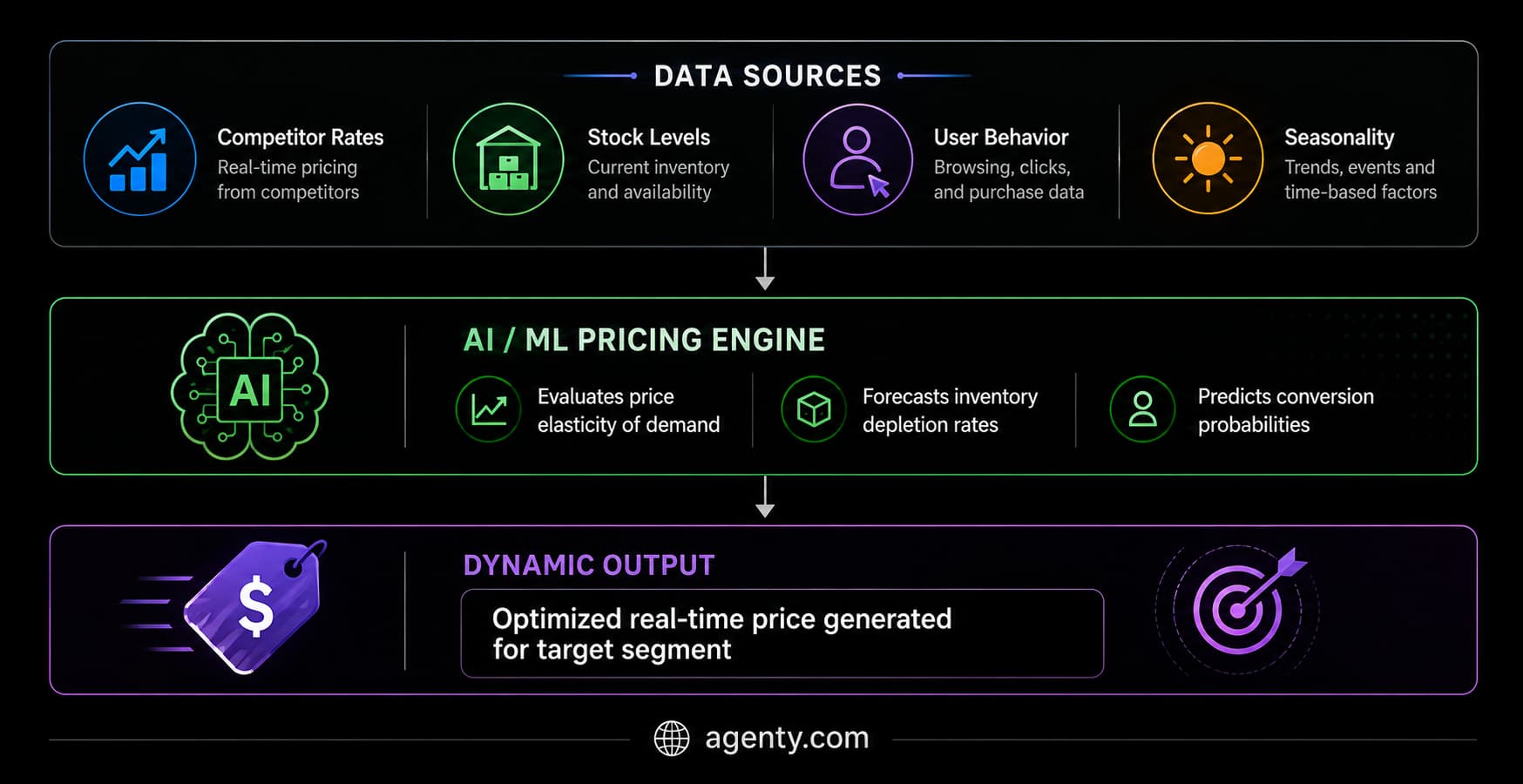
To function effectively, an AI pricing engine ingests several key data parameters:
- Competitor Intelligence: Live prices, stock availability, and shipping costs extracted across competitor websites.
- Internal Operations: Current inventory levels, cost of goods sold (COGS), return rates, and order fulfillment expenses.
- Market Signals: Historical sales volume, seasonal demand peaks, day-of-week trends, and macroeconomic indicators.
- Behavioral Data: Search queries, cart additions, session frequency, and cross-category browsing patterns.
By processing these inputs simultaneously, machine learning platforms optimize prices based on specific strategic goals. Whether that means maximizing short-term revenue, liquidating aging stock, or prioritizing customer acquisition. Utilizing modern data pipelines and web scraping with AI ensures these pricing algorithms are fed clean, reliable web data continuously.
Real-Time Dynamic Pricing: The Amazon Model
Amazon set the benchmark for algorithmic pricing in e-commerce. Managing hundreds of millions of SKUs, the retail giant updates product prices millions of times per day.
For key high-demand categories, Amazon can modify an item’s price every 10 to 15 minutes. A single product might fluctuate significantly over the course of a year based on stock levels, competitor moves, and seasonal velocity.
Amazon’s pricing strategy relies on several key operational principles:
- Predictive Inventory Positioning: By forecasting demand down to specific regional zip codes, inventory is staged closer to anticipated buyers, reducing delivery times and fulfillment overhead.
- Strategic Loss-Leaders: High-visibility items are priced aggressively low to win buy boxes and draw shoppers into the platform, while related add-ons maintain higher profit margins.
- Behavioral Adaptability: Rather than simply matching the lowest rate on the web, algorithms determine the highest possible price point that will still secure a conversion based on customer trust and delivery speed.
Dynamic Pricing vs. Personalized Pricing
While often discussed together, dynamic pricing and personalized pricing refer to distinct concepts in e-commerce revenue management.
- Dynamic Pricing relies on market-side variable inputs. The price changes based on factors external to an individual buyer - such as overall demand, inventory constraints, time of day, or competitor pricing. Every user viewing the page at the exact same moment under the same conditions sees the same price.
- Personalized Pricing relies on customer-side variable inputs. The system evaluates specific demographic, behavioral, or historical data attached to an individual profile or browser session. Two users visiting the same product page simultaneously might see different price tags based on their historical lifetime value, loyalty status, or purchase propensity.
| Feature | Dynamic Pricing | Personalized Pricing |
|---|---|---|
| Primary Focus | Market supply, demand, and competition | Individual customer profile and shopping behavior |
| Data Requirements | Competitor rates, inventory levels, time/date | Browsing history, past purchases, user segment, device type |
| Targeting | Broad market segments or all site visitors | Specific individuals or micro-cohorts |
| Consumer Perception | Generally accepted (e.g., airline tickets, top hotels chains) | Sensitive; requires transparent value exchange (e.g., loyalty discounts) |
| Implementation Risk | Margin erosion during automated price wars | Regulatory scrutiny and customer dissatisfaction |
Combining Dynamic and Personalized Models
Pure personalized pricing can trigger negative consumer reactions if customers feel unfairly targeted based on personal attributes. The most effective e-commerce strategy combines both approaches into a unified model:
- Use dynamic pricing to calculate the optimal market base price for a product based on real-time supply, demand, and competitive positioning.
- Apply personalized discounts or targeted offers (such as loyalty points, personalized coupons, or bundle deals) on top of the base dynamic price to drive individual conversions.
This hybrid model gives merchants the margin protection of dynamic pricing while delivering the tailored value buyers expect.
Core Advantages of AI-Driven Pricing
Adopting machine learning for price management provides clear operational and financial benefits for e-commerce brands:
Advanced Predictive Analytics
Traditional statistical forecasting relies on historical averages, which often fail during sudden market shifts. Machine learning algorithms identify non-linear relationships between variables, allowing merchants to predict how a price change will impact sales velocity before making the change live.
Workflow Automation and Operational Scale
Monitoring thousands of competitor web pages manually is impossible. Automated workflows capture price adjustments across competitor catalogs and execute strategy updates automatically. Setting up a dedicated change detection agent allows merchandising teams to receive instant alerts when a competitor updates prices or runs out of stock, triggering automated repricing rules instantly.
Optimized Margin Performance
AI pricing engines help online retailers move away from blanket storewide discounts. By identifying which products have inelastic demand, businesses can protect baseline margins while selectively discounting price-sensitive items to drive traffic.
Lifecycle Optimization
Products move through distinct sales stages: launch, peak growth, maturity, and clearance. AI models adjust pricing strategies dynamically across this lifecycle, charging a premium during launch windows and systematically reducing prices to clear aging inventory without cannibalizing profit margins.
Practical Steps to Implement Dynamic Pricing
Implementing an effective dynamic pricing system requires a reliable data foundation, solid integrations, and clear business rules.
Step 1: Define Rules & Margin Floors
  └── Establish minimum profit margins, brand MAP guidelines, and target repricing boundaries.

Step 2: Connect External Data Feed
  └── Set up scrapers or APIs to collect competitor pricing and stock levels in real time.

Step 3: Feed AI Model & Test Strategy
  └── Process inventory, demand signals, and market data through predictive pricing engines.

Step 4: Execute via API & Webhooks
  └── Sync calculated prices directly to your e-commerce platform catalog automatically.
1. Establish Guardrails and Rules
Before granting control to an algorithm, establish clear operational guardrails:
- Set strict minimum margin floors to prevent automated price wars from eroding profits.
- Configure Minimum Advertised Price (MAP) rules to stay compliant with brand manufacturer agreements.
- Define maximum price ceilings to prevent accidental price gouging during supply shortages.
2. Build a Continuous Market Data Pipeline
An AI model is only as effective as the data it ingests. To make accurate pricing decisions, your pricing engine needs access to fresh, clean market data. Set up automated web scrapers to monitor competitor URLs, extract price variations, detect promotional tags, and check stock status.
3. Integrate Systems via Webhooks and APIs
Once the pricing model calculates a new rate, that update must reflect immediately across your sales channels (Shopify, Magento, Amazon, BigCommerce). Use reliable webhook architecture to pass updated prices directly from your pricing tool into your inventory management and e-commerce platforms with minimal latency.
4. Monitor Performance and Refine Algorithms
Dynamic pricing is an iterative process. Regularly evaluate machine learning outputs against core business metrics, including conversion rate, gross margin dollars, inventory turn rate, and average order value (AOV). Adjust algorithm weights periodically to align with shifting business objectives.